
- 100%free for soldiers who took part in the war, as Hyebrid states on its website; the conditions are not published there
- 300+Hyebrid devices implanted in patients by early 2026, the first in 2021: the company's own figure (catalogue, pp. 1 and 7), for all patients, not only soldiers
- 54custom titanium plates and prostheses had been made for veterans as of 2023, according to a column in EVN Report
What Hyebrid makes and what is distinctive about its products
Hyebrid (the logo reads HYEBRID TECHNOLOGIES) is a laboratory in Yerevan. According to its catalogue, the company was founded in early 2021 (p. 1); its website and 2021 publications also use the earlier name Hybrid Laboratory. It was set up by Diaspora Armenians from France, Russia, Germany, the United States and Lebanon together with local partners, as the Public Radio of Armenia reported on 23 September 2021, citing the Office of the High Commissioner for Diaspora Affairs; by then, it added, 11 soldiers had already had titanium prostheses implanted. The catalogue names Karen Karapetyan as founder and Artur Khachatryan as CEO; the devices are designed by General Biomedical Engineer Bagrat Baghdasaryan, and each design is reviewed and validated by the operating surgeon or, where appropriate, by a multidisciplinary clinical board (p. 1). The products are made on a metal 3D printer: a laser fuses metal powder layer by layer (selective laser melting, SLM). A surgeon implants them: according to EVN Report, Hyebrid delivers the finished items to hospitals. What the range includes, according to the 2026 catalogue (pp. 6–34):
- neurosurgery: a Simple Cranioplasty Implant to close cranial vault defects after trauma, decompressive craniotomy and other causes (p. 8); an Expanding Paediatric Cranioplasty System designed with skull growth in mind (p. 11); Craniosynostosis Surgical Guides for osteotomies when skull sutures fuse too early (p. 15); standard titanium plates for fixing bone fragments (p. 16);
- jaw: a Patient-specific Graft Mesh that holds a bone graft (p. 17); a Patient-specific Subperiosteal Implant for severe jaw atrophy when conventional dental implants cannot be placed (p. 18); a Segmental Jaw Replacement Functional Implant after resection or trauma (p. 19); a Segmental Jaw Replacement Autograft Set for rebuilding the jaw with the patient's own bone, such as a fibula flap (p. 20); a Patient-specific Mandibular Reconstruction Plate, the Megaplate (p. 21);
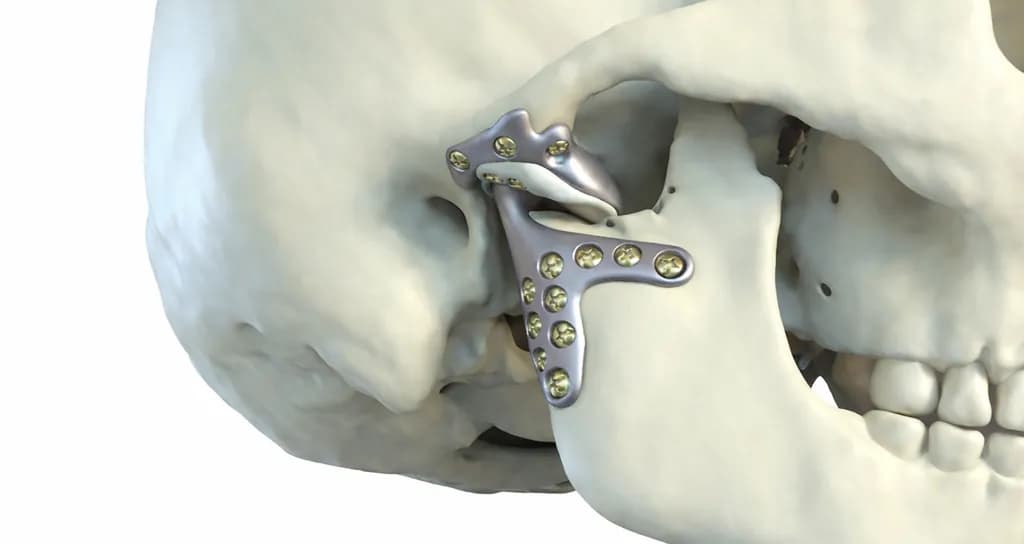
- joint: a patient-specific Total Temporomandibular Joint (TMJ) Replacement System (p. 22), the only joint in the catalogue;
- a Mandibular Paediatric Expanding System designed to adapt to growth; according to the catalogue, its installation is scheduled for 2026 (p. 24);
- face: a Patient-specific Orbital Reconstruction Implant and an Orbitozygomatic Complex Reconstruction Implant (pp. 27–28), a Volumetric Contour Augmentation Implant (p. 29), and an Orthognathic Surgery Set and a Genioplasty Set of guides and fixation components for jaw and chin surgery (pp. 30–32);
- standard products: a Standard Graft Mesh (0.3–0.6 mm) and Maxillofacial Osteosynthesis Standard Plates (pp. 33–34).
The key feature is that, apart from the standard plates and meshes, devices are not picked from stock sizes: each is designed for a single person from their CT and 3D scan data, so that it matches the anatomy precisely (catalogue, p. 1). Patient-specific implants are printed from the titanium alloy Ti-6Al-4V ELI (Grade 23), which meets the ASTM F136 standard for surgical implants, while the standard plates and meshes are made of commercially pure titanium Grade 2 (pp. 2, 16, 33–34, 36). The catalogue also lists cobalt–chromium alloy, zirconia, the polymers PEEK and PMMA, and ultra-high-molecular-weight polyethylene among the company's materials, and surgical guides and anatomical models are printed from medical-grade acrylic resin (pp. 2–4). For load-bearing implants, strength is calculated in advance on a computer model using finite element analysis (pp. 5, 36). The standard plates come with either a smooth polished surface or a proprietary surface treatment, EAAM, which the company says is intended to support osseointegration (pp. 16, 34), and biocompatibility is evaluated under the ISO 10993 series (p. 36). The company's catalogue calls its two paediatric systems, for the skull and the lower jaw, “first in the world” (pp. 11, 24); the paediatric cranioplasty system was first installed in 2022, according to the catalogue. We found no independent confirmation of this. In its scientific work, Hyebrid names the Institute of Molecular Biology of the National Academy of Sciences of Armenia and the CANDLE Synchrotron Research Institute as partners (p. 36). All of these are the company's own descriptions: we found no independent data on outcomes.
On registration, the catalogue says the company plans to apply for CE marking in the European Union after a five-year clinical observation period, and that a submission to the US FDA is also only planned (p. 35). The contacts page at the end of the catalogue gives an ISO 13485:2016 certificate for “MEDICAL” LLC. This is a standard for the manufacturer's quality management system, not an approval of the devices themselves. The catalogue does not say who issued the certificate, and we have not checked it against a register. The catalogue does not mention registration with the Armenian Ministry of Health; if this matters to you, ask the company and the surgeon.
Who it is free for and what to check
At the bottom of the hyebrid.tech home page there is a separate block about the military. The English version says “100% Free” “For all those soldiers, who took part in the war”; the Russian version also says 100% free, while the Armenian version says “100% discount” for all servicemen who took part in the war. It refers to the production of titanium articular heads, implants and prostheses. Other sources also confirm that the work is free for the military: a column in EVN Report dated 15 February 2023 says the appliances are provided “free of charge”, and the company's listing in the yell.am directory, updated in July 2026, mentions a “Free Service for Military Personnel”. The company's 2026 catalogue says nothing about this: it mentions war only once, as the reason the company was founded (p. 1). The rest of the company's work is commercial and, according to the website, is aimed at doctors, dentists and laboratories. The only price list on the site covers dental laboratory work and was valid from 20 September to 20 November 2021, and the catalogue gives no prices, so we do not quote any; ask the company what an implant costs for a civilian patient.
How to contact Hyebrid
| Item | As listed |
|---|---|
| Phone | +374 33 05 83 05 |
| info@hyebrid.tech | |
| Address | 138/3 Verin Antarayin St., Yerevan 0009 |
| Contact form | on hyebrid.tech, “Get in touch” section |
| Opening hours | Mon–Sat 09:00–20:00, Sun closed; according to yell.am, please check |
Phone, email and address are from hyebrid.tech, taken on 3 October 2026; this is the main phone number on the site, and the 2026 catalogue gives the same contacts. The 2021 price list gives another phone number, an email address and a website on the former domain hybridlaboratory.com, which no longer opens. The website does not describe how servicemen should apply.
The implant is placed by a surgeon in a hospital, so it is worth discussing it with the doctor treating the patient as well: a neurosurgeon or a maxillofacial surgeon. In its catalogue the company says the implant material is not a contraindication for MRI, CT or EEG, but it may cause artefacts on the images (p. 7): before any scan, tell the doctor that you have a titanium implant.
If you need an arm or leg prosthesis
Hyebrid's 2026 catalogue lists no arm or leg prostheses: neither those worn over a residual limb nor hip, knee, shoulder or elbow joint replacements. All of its products are for the skull and the jaw and face, and the only joint is the temporomandibular joint (pp. 6, 22), although the “About us” section says the laboratory makes prosthetic solutions for reconstruction “throughout the body” (p. 1). Other sources say otherwise: the yell.am directory lists hip, knee, shoulder and elbow joint prostheses among the company's products, the Armenian text of the company's website names people who have lost limbs among those who need its products, and a 2023 column in EVN Report says Hyebrid's expertise also covers customising limb prostheses. Ask the company directly whether it currently makes anything for arms or legs.
Arm and leg prostheses are also made by prosthetics centres. One of them operates at the Zinvori Tun (“Soldier's Home”) rehabilitation centre. According to the centre's website, it was set up in 2018 by a non-governmental organisation together with Yerevan State Medical University and the Ministry of Defence, and people wounded while defending the homeland receive free rehabilitation treatment there. According to the same website, a prosthetics centre opened there in April 2021, where soldiers who lost arms or legs in the 2020 war received prostheses. Address: 58 Abovyan St., Yerevan; phone (011) 202520. The Medaro catalogue also lists other prosthetics centres, Interorto and NANO-PRO; ask them directly about terms for servicemen.
Hyebrid products: images from the catalogue
Below are Hyebrid products from the company's 2026 catalogue (second edition): the first is a photograph, the others are 3D images of the devices that the company included in the catalogue. The article's cover image is also from the catalogue: a temporomandibular joint replacement on a skull model (p. 22). The catalogue was provided by the company and is not published on hyebrid.tech. We do not publish the catalogue's images of patients.

A skull model with Hyebrid titanium implants on the cranial vault, around the eye socket and cheekbone, and on the lower jawPhoto: Hyebrid catalogue 2026, p. 6 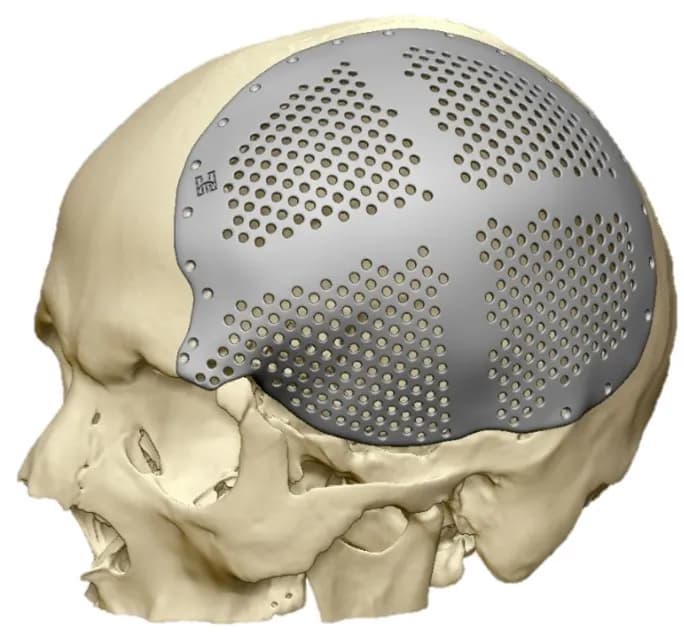
A patient-specific cranioplasty implant: a perforated titanium plate on a skull modelImage: Hyebrid catalogue 2026, p. 8 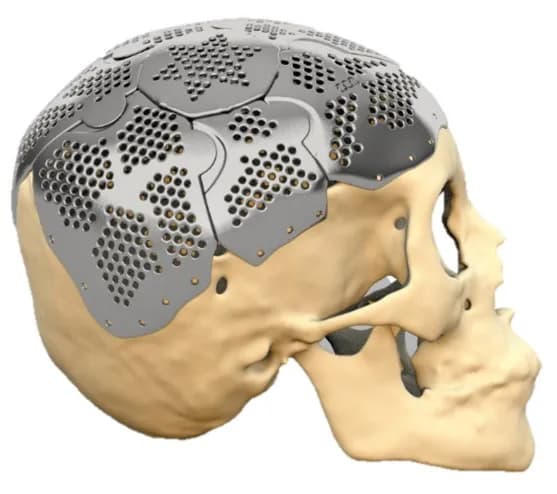
Expanding Paediatric Cranioplasty System on a skull modelImage: Hyebrid catalogue 2026, p. 11 
Patient-specific titanium mesh for a jaw bone graftImage: Hyebrid catalogue 2026, p. 17 
Patient-specific subperiosteal jaw implantImage: Hyebrid catalogue 2026, p. 18 
Segmental jaw replacement implant on a model of the lower jawImage: Hyebrid catalogue 2026, p. 19 
Standard titanium graft meshes, 0.3–0.6 mm thickImage: Hyebrid catalogue 2026, p. 33 
Standard titanium osteosynthesis platesImage: Hyebrid catalogue 2026, p. 34
When an article is not the answer — call 103
With these signs you do not look up prices or book a test; you call an ambulance.
- After skull surgery: a worsening headache, new or increasing weakness in an arm or leg, new speech problems, drowsiness, or seizures or blackouts you have not had before. A factsheet from the neurological centre of University Hospital Southampton (NHS) says to contact the ward where you had surgery straight away. Medaro's rule: for seizures, loss of consciousness or a sudden deterioration, call 103.
- After skull surgery: leakage from the wound, increasing redness or swelling, increasing pain around the wound, or a high temperature. The same factsheet lists these as possible signs of infection and a reason to contact the ward where you had surgery.
- On the residual limb after amputation: warm, red and tender skin, discharge or pus, or increasing swelling. NHS calls these signs of infection and advises contacting your care team.
Where the data comes from
- Hyebrid catalogue 2026, second edition (PDF in English, 40 pages; provided by the company, not published on its website): about the company, materials and technology, product range, 300+ devices implanted as of early 2026, CE and FDA plans, ISO 13485:2016 certificate, contacts, images in this article (pages given in the text) — data as of
- Hyebrid — company website in Armenian, Russian and English: the “100% Free” block for all soldiers who took part in the war (“100% discount” in the Armenian version), mention of people who have lost limbs (Armenian text), contacts, dental laboratory price list (valid 20.09–20.11.2021) — data as of
- yell.am — listing for “Hybrid Technologies” Bone Substitutes Production: product list (including hip, knee, shoulder and elbow joint prostheses, which are not in the 2026 catalogue), “Free Service for Military Personnel”, opening hours (updated 11.07.2026) — data as of
- EVN Report — column by Varouj Vartanian, “Improving the Quality of Life for Wounded Veterans”, 15.02.2023: free of charge for the military, custom limb prostheses, 54 plates and prostheses for veterans, finished items delivered to hospitals — data as of
- Public Radio of Armenia — “Armenia starts production of titanium prostheses for wounded soldiers”, 23.09.2021: the laboratory was set up by Diaspora Armenians with local partners; 11 soldiers have already had titanium prostheses implanted — data as of
- Zinvori Tun — About us (in Armenian; translation by Medaro): founded in 2018, free rehabilitation treatment for people wounded defending the homeland, prosthetics centre since April 2021, address and phone — data as of
- NHS — “Amputation”: signs of infection on the stump, deep vein thrombosis and other complications (page last reviewed 17.02.2023; the scheduled review on 17.02.2026 is overdue) — data as of
- University Hospital Southampton NHS Foundation Trust, Wessex Neurological Centre — “After a craniotomy” factsheet (version 3, reviewed September 2025): symptoms for which to contact the ward and signs of wound infection — data as of
This material is for reference and does not replace a consultation: it contains no diagnoses, treatment plans or dosages. Prices and tariffs change — check the terms with the organisation and with the fund before your visit. Medaro does not provide medical services and does not take appointments.